
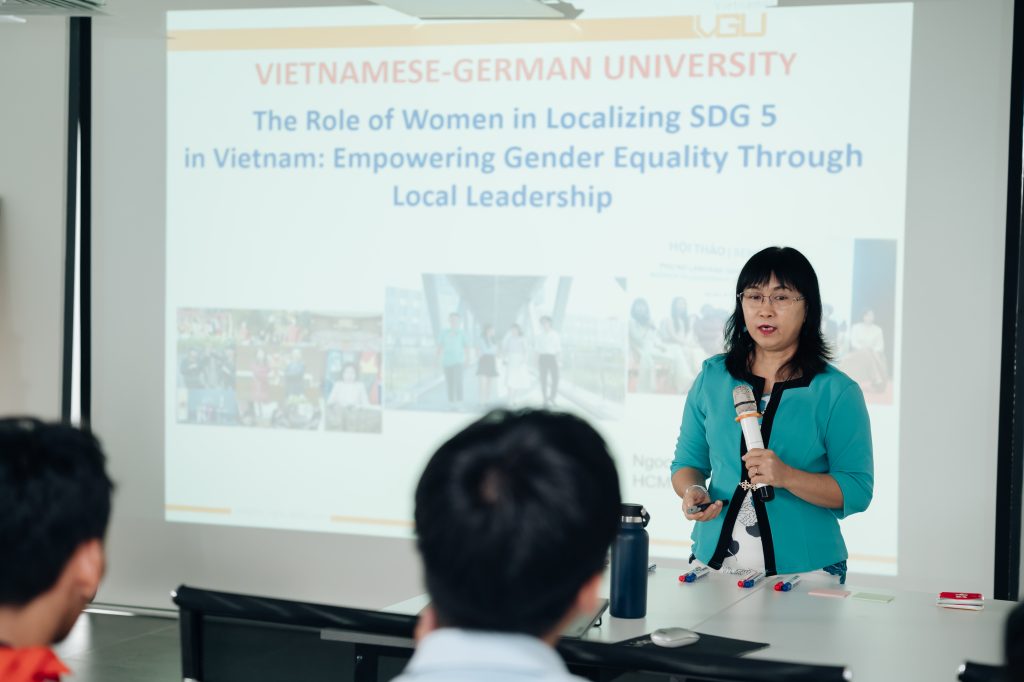
At the LeadHerShip Young Professional Summit 2025, held on October 11–12 in Ho Chi Minh City, Dr. Đặng Thị Ngọc Lan, Lecturer at the Vietnamese-German University (VGU), delivered an insightful presentation on “The Role of Women in Localizing SDG 5: Empowering Gender Equality Through Local Leadership.”
Her keynote provided a comprehensive view of how Vietnam is advancing gender equality at national and local levels, while highlighting the crucial role of women as community leaders and agents of sustainable change.
 Gender Equality – A Foundation for Sustainable Development
Dr. Lan began by emphasizing that Sustainable Development Goal 5 (SDG 5) — Achieve gender equality and empower all women and girls — is not just one among 17 goals, but a cross-cutting foundation for all others.
“Gender equality is more than a goal; it is a precondition for a better world,”
she quoted from UN Women (2022).
She presented global statistics showing progress in education and representation but also persistent gaps: women earn 23% less than men globally and hold less than 25% of parliamentary seats.
 Vietnam’s Progress and Leadership
Vietnam stands out as one of the leading countries in Asia in promoting gender equality in education and political representation.
-
- 30% of National Assembly seats are held by women — one of the highest rates in the region.
-
- Women’s labor participation rate remains high, at nearly 69%.
-
- Women own about 28% of businesses nationwide, reflecting increasing engagement in entrepreneurship.
Yet, as Dr. Lan pointed out, barriers persist — including cultural norms, limited access to finance, and underrepresentation in senior leadership positions
 Localizing SDG 5 in Vietnam
Dr. Lan detailed how Vietnam has integrated SDG 5 into its National Strategy on Gender Equality (2021–2030). This framework guides both national and provincial action plans, ensuring gender perspectives are embedded in policies across sectors.
Local authorities, Women’s Unions, and development partners such as UNDP, UN Women, and Oxfam Vietnam are key drivers of implementation. Examples include:
-
- Women-led cooperatives in Hue promoting sustainable farming and community leadership;
-
- Digital inclusion programs in Hanoi and Da Nang empowering women entrepreneurs;
-
- Microfinance and training projects improving rural women’s economic resilience
 Challenges and Next Steps
Despite impressive progress, Dr. Lan highlighted several challenges:
-
- Persistent gender pay gaps (13–29%), especially in rural areas;
-
- Underrepresentation in senior decision-making roles;
-
- Limited funding and monitoring capacity for local gender plans;
-
- Continued gender-based violence and social expectations restricting leadership roles.
Her call to action was clear:
“We need stronger data, enforcement, and partnerships to make gender equality real at every level — from national policy to neighborhood action.”
 Empowering Women, Empowering Communities
Dr. Lan concluded with an inspiring message that resonated with the Summit’s theme:
“Empowering one woman empowers an entire community.”
Her talk reminded participants that localizing SDG 5 is a collective effort — requiring collaboration between government, academia, civil society, and young leaders.
Through data, stories, and real examples, Dr. Lan demonstrated how empowering women is not just about fairness — it’s about building a more resilient, inclusive, and sustainable Vietnam.